Two-day meeting spring 2026
Dates
The two-day meeting this spring 2026 will take place in Aalborg, 4-5 May, 2026.
Venue
Faculty of Health, Selma Lagerløfs Vej 249, 9260 Gistrup
- Monday 4 May 2026: Room SLV249 11.00.035
- Tuesday 5 May 2026: Room SLV249 11.00.035
Organizers
Heidi Søgaard Christensen, Rasmus Froberg Brøndum, and Martin Bøgsted, Center for Clinical Data Science (CLINDA), Aalborg University and Aalborg University Hospital.
Registration
Conference fee:
- Regular DSTS members: DKK 950
- Honorary, retired and student (MSc, BSc) members: DKK 250
- All others: DKK 1475
The conference fee covers hot and cold drinks, lunch, cake, snacks, dinner, and sandwiches.
Please register before 31 March 2026 here
Sponsors
The conference is supported by Danish Data Science Academy (DDSA)
Preliminary programme
Programme Day 1
| Time | Activity | Speaker |
|---|---|---|
| 11.30-12.15 | Lunch and registration | |
| 12.15-12.30 | Welcome | Rasmus Froberg Brøndum, Heidi Søgaard Christensen, and Martin Bøgsted, CLINDA Aalborg University and Aalborg University Hospital |
| 12.30-14.00 | Biostatistics Chair: Heidi Søgaard Christensen, Asssociate Professor CLINDA |
|
| 12.30-13.10 | “Deriving Complete Constraints in Hidden Variable Models” (Abstract) (Slides) | Erin Evelyn Gabriel, Professor Section of Biostatistics, Department of Public Health, University of Copenhagen |
| 13.10-13.35 | “From pharmacy dispensing dates to treatment episodes – methodological development based on the Waiting Time Distribution” (Abstract) (Slides) | Henrik Støvring, Professor, Steno Diabetes Center, Department of Biomedicine, Aarhus University |
| 13.35-14.00 | “When Winning Isn’t Clear: Statistical Properties of the Win Ratio That Complicate Clinical Interpretation” (Abstract) (Slides) | Henrik Thomsen, Researcher Novo Nordisk Biostatistics Obesity and Cardiometabolic |
| 14.00-14.30 | Coffee break | |
| 14.30-16.00 | Representation learning Chair: Rasmus Rask Kragh Jørgensen, Postdoc, CLINDA |
|
| 14.30-15.10 | “Representation learning with applications in cancer evolution and spermatogenesis” (Abstract) | Asger Hobolth, Professor Department of Mathematics, Aarhus University |
| 15.10-15.35 | “Mutational Signatures Using Neural Networks for Robust Stratification of Cancer Patients” (Abstract) (Slides) | Ida Burchardt Egendal, Postdoc. Department of Forensic Medicine Aarhus University |
| 15.35-16.00 | “Distributional Active Inference” (Abstract) (Slides) | Melih Kandemir, Associate Professor Department of Mathematics and Computer Science, University of Southern Denmark |
| 16.00-16.20 | Optional Guided Tour of the premises |
Rasmus Froberg Brøndum, Heidi Søgaard Christensen, and Martin Bøgsted, CLINDA Aalborg University and Aalborg University Hospital |
| 16.00-18.30 | Transportation to Hotel Comwell Hvide Hus Aalborg. Address: Vesterbro 2, 9000 Aalborg | For more information regarding transport, hotel booking and parking see below |
| 18.30-21.30 | Dinner at Hotel Comwell Hvide Hus Aalborg |
Programme Day 2
| Time | Activity | Speaker |
|---|---|---|
| 08.30-09.00 | Coffee and water | |
| 09.00-10.30 | Bioinformatics Chair: Rasmus Froberg Brøndum, Associate Professor, CLINDA |
|
| 09.00-09.40 | “Research, courtroom, and media: a forensic statistician’s perspective” (Abstract) (Slides) | Mikkel Meyer, Associate Professor Department of Mathematical Sciences, Aalborg University |
| 09.40-10.05 | “Multi-trait Models” (Abstract) (Slides) | Emil Michael Pedersen, Postdoc, Institut for Folkesundhed - Center for Registerforskning |
| 10.05-10.30 | “Integrating high-dimensional biomarker data into randomized clinical trials for mechanism-of-action understanding and decision-making” (Abstract) | Kristian Hessellund, Statistical Specialist Novo Nordisk, Aalborg Department |
| 10.30-11.00 | Coffee break and a snack | |
| 11.00-12.30 | Privacy enhancing techniques Chair: Martin Bøgsted, Professor and Head of CLINDA |
|
| 11.00-11.40 | “Privacy Enhancing Technologies and Their Applications” (Abstract) (Slides) | Sam Leder, Netherlands Institute for Applied Scientific Research (TNO), The Hague, Netherlands |
| 11.40-12.05 | “Deceptively Real – Yet Privacy-Compliant? Synthetic Data with Formal Privacy Guarantees” (Abstract) (Slides) | Marcel Neunhoeffer, Postdoctoral Researcher Ludwig Maximilians University, Munich and Institute for Employment Research (IAB), Nuremberg |
| 12.05-12.30 | “Development of time to event prediction models using federated learning” (Abstract) (Slides) | Rasmus Rask Kragh Jørgensen Postdoc. CLINDA Aalborg University |
| 12.30-12.40 | Closing remarks | Martin Bøgsted, Professor and Head of CLINDA |
| 12.40 | Sandwiches to go |
Conference Contact
Questions regarding registration for the conference and the conference programme please contact Henriette Bøttcher at herobo@dcm.aau.dk
Hotel, Rooms and Parking
Questions regarding Hotel Comwell Hvide Hus, Aalborg and parking please find answers and more information here
For hotel booking please use this code BC-AAU-040526 and follow the guide from the hotel available in both Danish and English or call: +45 9813 8400 press 2. 30 rooms are reserved until 20 April 2026. This special rate is offered on a first come, first served basis. Dinner in the evening will be at the hotel.
Transportation
Transportation from The Faculty of Health, Selma Lagerløfs Vej 249, 9260 Gistrup to Hotel Comwell Hvide Hus, Aalborg, you have several options:
- Taxi: Uber app or call 4848 4848 or 3510 2030
- Bus: Bus no. 2 from Selma Lagerløfs vej/Bertil Ohlins vej to John F. Kennedys Plads (approx. 25 min. bus ride) From John F. Kennedys Plads short walk through Kildeparken to Hotel Comwell Hvide Hus (approx. 10 min. walk).
Parking at campus
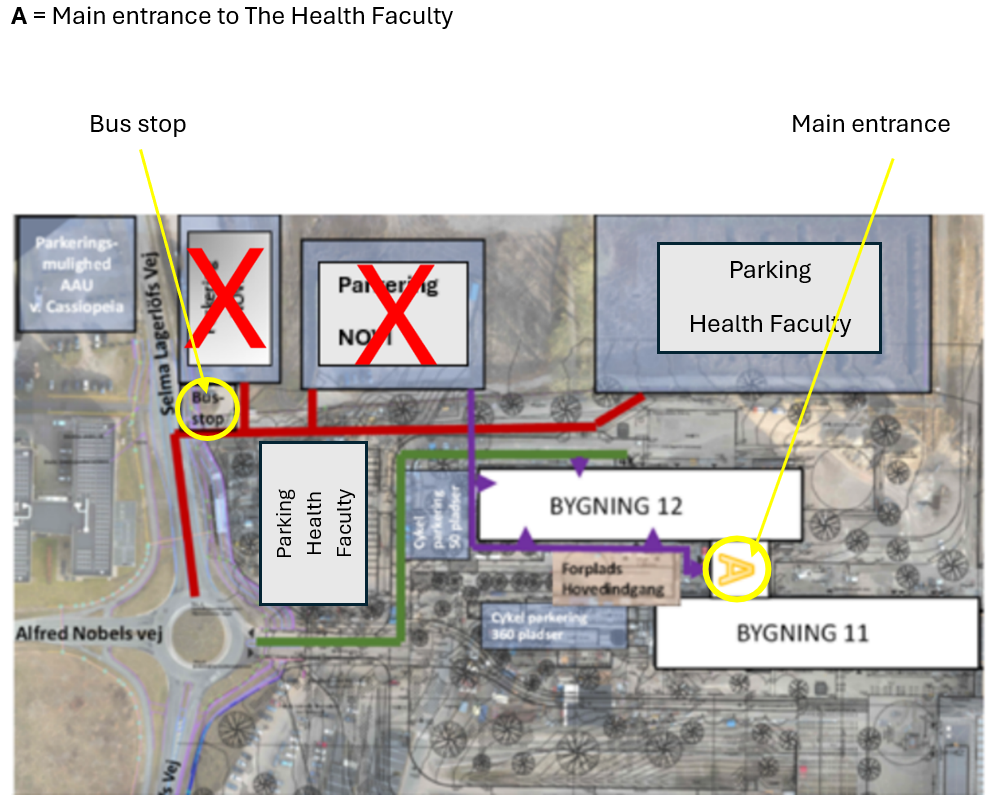
Parking at The Faculty of Health, Selma Lagerløfs Vej 249, 9260 Gistrup. Please remember to register your parking via the QR code at the main entrance by using the license plate number. Parking is free in the designated areas (see below) but registration is necessary.
Abstracts
Henrik Støvring - From pharmacy dispensing dates to treatment episodes – methodological development based on the Waiting Time Distribution
Affiliation:
- Department of Biomedicine, Aarhus University
- Steno Diabetes Center, Aarhus University Hospital
- Clinical Pharmacology, Pharmacy and Environmental Medicine, University of Southern Denmark
Title: From pharmacy dispensing dates to treatment episodes – methodological development based on the Waiting Time Distribution
Pharmacoepidemiology is concerned with investigating effects and side-effects of medication use. The key exposure information is therefore use of medication at a specific point in time, possibly supplemented with information on, for example, cumulative dose and duration of treatment. Pharmacoepidemiologic databases record dates of dispensations of medication to patients and from these, exposure status must then be constructed. In my presentation I will introduce the parametric Waiting Time Distribution model and how it can be used for this purpose. As the model is parametric and amenable to maximum likelihood estimation, I will present extensions which allow use of covariates (patient and medication characteristics), can improve precision and can handle seasonal variation. The primary objective of my presentation is to invite new suggestions for further development and applications as the method is now available in a new R package (wtdr) available on GitHub.
Henrik Thomsen - When Winning Isn’t Clear: Statistical Properties of the Win Ratio That Complicate Clinical Interpretation
Affiliation:
- Novo Nordisk A/S, Biostatistics Obesity and Cardiometabolic 6, Aalborg, Denmark
Title: When Winning Isn’t Clear: Statistical Properties of the Win Ratio That Complicate Clinical Interpretation
The Win Ratio analyzes hierarchical composite endpoints through pairwise patient comparisons between treatment arms. Despite widespread use, several statistical properties complicate interpretation. We examine five challenges using cardiovascular and kidney disease examples: unclear estimand definition when combining heterogeneous outcomes; divergence between population-level and individual-level effect measures; non-transitivity producing circular treatment hierarchies; dependence on outcome variance and measurement precision rather than location shift alone; and non-collapsibility across subpopulations. Win Ratio magnitude thus conflates treatment effect with study design features and population heterogeneity. We discuss implications for trial design, network meta-analysis, and clinical interpretation, emphasizing complementary analyses of individual endpoint components.
Asger Hobolth - Representation learning with applications in cancer evolution and spermatogenesis
Affiliation:
- Department of Mathematics, Aarhus University
Title: Representation learning with applications in cancer evolution and spermatogenesis
This talk falls in two parts. In the first part I plan to review unsupervised learning methods for high-dimensional data. I will describe common methods such as principal component analysis, K-means clustering, non-negative matrix factorization, and auto-encoders. A main focus is to describe the various methods in terms of probabilistic models, and a common feature is low-rank factorization. In the second part I will explain recent attempts to apply the methods for understanding cancer evolution and spermatogenesis. In connection with the applications I will discuss important decisions concerning model selection, and challenging aspects of parameter estimation.
Ida Burchardt Egendal - Mutational Signatures Using Neural Networks for Robust Stratification of Cancer Patients
Affiliation:
- Department of Forensic Medicine, Aarhus University
Title: Mutational Signatures Using Neural Networks for Robust Stratification of Cancer Patients
Mutational signature analysis is a key approach for characterizing the mutational processes in cancer genomes. Traditionally these have been identified with non-negative matrix factorization (NMF), in part, due to their straightforward interpretability. However, NMF relies on restrictive assumptions that may be insufficient for modeling the complexity of cancer genomes. We propose VAE-MS, a variational autoencoder-based framework that provides a non-linear and probabilistic representation, aimed to better capture mutational complexity while retaining interpretability.
In parallel, there is a need for improved biomarkers of homologous recombination deficiency (HRD) in ovarian cancer (OC), as current identification methods only capture a subset of HRD cases. Validating the clinical utility of VAE-MS on a cohort of patients with OC, we found that mutational signature-derived HRD biomarkers yielded an improved prognostic stratification. These findings support autoencoder-based mutational signature analysis as a promising direction for both methodological development and clinical biomarker discovery.
Melih Kademir - Distributional Active Inference
Affiliation:
- Department of Mathematics and Computer Science, University of Southern Denmark
Title: Distributional Active Inference
Optimal control of complex environments with robotic systems faces two complementary and intertwined challenges: efficient organization of sensory state information and far-sighted action planning. As the reinforcement learning framework tackles only the latter problem, it tends to deliver sample-inefficient solutions. Active inference is the state-of-the-art process theory that explains how biological brains handle this dual problem by a specific form of approximate Bayesian inference. However, its applications to artificial intelligence have thus far been limited to extensions of existing model-based approaches. I will present a formal abstraction of reinforcement learning algorithms that span model-based, distributional, and model-free approaches. I will also show how this abstraction seamlessly integrates active inference into the distributional reinforcement learning framework, making its performance advantages accessible at a reduced computational cost.
Mikkel Meyer - Research, courtroom, and media: a forensic statistician’s perspective
Affiliation:
- Department of Mathematical Sciences, Aalborg University, Denmark
- Section of Forensic Genetics, Department of Forensic Medicine, University of Copenhagen, Denmark
Title: Research, courtroom, and media: a forensic statistician’s perspective
DNA evidence plays a pivotal role in modern criminal investigations, relying fundamentally on rigorous statistical interpretation. In this talk, I will present how different types of DNA profiles are applied in forensic investigations and how the weight of evidence is evaluated using statistical methods. I will also share my experience in communicating complex results to diverse audiences, including the public and media. Finally, I will offer observations from my work as an interdisciplinary statistician, reflecting on the challenges and rewards of bridging legal, scientific, and media domains.
Emil Michael Pedersen - Multi-trait liability model for gene discovery and prediction in large biobanks
Affiliation:
- National Centre for Register-Based Research, Aarhus University, Aarhus, Denmark
- Institute of Biological Psychiatry, Mental Health Center - Sct Hans, Copenhagen University Hospital, Copenhagen, Denmark
Title: Multi-trait liability model for gene discovery and prediction in large biobanks
Large-scale biobanks provide unprecedented opportunities to study the genetic architecture of complex diseases, yet effective use of broad and heterogeneous phenotypic data remains challenging. We have developed a novel multi-trait method for estimating a genetic liability within the liability threshold model, flexibly integrating genetically correlated phenotypes, age of onset, and family history, conditional on data availability. These liability estimates are used to improve genetic prediction and increase power for gene discovery in genome-wide association studies (GWAS). The method will be evaluated against state-of-the-art multi-trait GWAS and polygenic score approaches using extensive simulations followed by applications to multiple Danish cohorts.
Kristian Hessellund - Integrating high-dimensional biomarker data into randomized clinical trials for mechanism-of-action understanding and decision-making
Affiliation:
- Novo Nordisk, Aalborg department
Title: Integrating high-dimensional biomarker data into randomized clinical trials for mechanism-of-action understanding and decision-making
High-dimensional biomarker data, like proteomics or metabolomics, are increasingly being generated from high-throughput external assays in randomized clinical trials (RCTs) sponsored by Novo Nordisk, since these data can be used for in-depth mechanism-of-action (MoA) understanding of investigational drug products. This presentation aims to showcase how high-dimensional biomarker data are utilized in the pharma industry for MoA understanding, precision medicine, and internal decision-making. The presentation considers statistical concerns and methodology related to high-dimensional biomarker data, with particular emphasis on causal inference and mediation analysis.
Sam Leder - Privacy Enhancing Technologies and Their Applications
Affiliation:
- TNO (Netherland’s Organisation for Applied Scientific Research)
Title: Privacy Enhancing Technologies and Their Applications
In many complex applications, data collaboration can improve outcomes or results. However, it is often difficult, unwanted or forbidden to share data between different entities. There seems to be a fundamental opposition between quality and data security.
Privacy Enhancing Technologies (PETs) refers to a collection of cryptographic techniques that enable secure collaborative computation, without requiring participants to make their information visible to others. In this talk, we discuss the various PETs that are in use today and their applications, as well as future prospects. This includes secure Cox regression that we have developed and implemented with Federated Learning and Multi-party Computation. This enables multiple parties (such as hospitals) to collaborate in order to achieve a better model that is trained with more data, but without the requirement of sharing any sensitive patient data with other parties.
Marcel Neunhoeffer - Deceptively Real – Yet Privacy-Compliant? Synthetic Data with Formal Privacy Guarantees
Affiliation:
- Institute for Employment Research (IAB), Nuremberg
- Ludwig-Maximilians University Munich, Germany
Title: Deceptively Real – Yet Privacy-Compliant? Synthetic Data with Formal Privacy Guarantees
Synthetic data has emerged as a promising approach for protecting sensitive information while preserving analytical utility. But how privacy-compliant is synthetic data actually, and under what conditions can formal guarantees be derived? This talk addresses these questions from two angles. First, I examine whether traditional synthesizers, designed without formal privacy guarantees, can nonetheless satisfy differential privacy. Using a simplified Gaussian setting, I show that certain parametric synthesizers directly translate into ρ-zCDP guarantees. However, extending this to realistic models proves considerably harder. Second, I present algorithms for continually releasing differentially private synthetic data from longitudinal studies, such as for example patient trajectories. These algorithms preserve a fixed time window and cumulative time queries with near-optimal error bounds. Together, these results highlight both opportunities and fundamental limits when balancing analytical utility against formal privacy protection in synthetic data generation.
Rasmus Rask Kragh Jørgensen1,2, Jonas Faartoft Jensen2, Tarec El-Galaly1,3,4,5, Martin Bøgsted2,6, Rasmus Froberg Brøndum2,6, Mikkel Runason Simonsen1,7, and Lasse Hjort Jakobsen1 - Development of time to event prediction models using federated learning
Affiliation:
- Center for Clinical Data Science, Aalborg University, Aalborg Denmark
- Department of Hematology, Aalborg University Hospital, Aalborg, Denmark
- Department of Clinical Medicine, Aalborg University, Aalborg, Denmark
- Department of Medicine Solna, Clinical Epidemiology Division, Karolinska Institutet, Stockholm, Sweden
- Department of Hematology, Odense University Hospital, Odense, Denmark
- Clinical Cancer Research Centre, Aalborg University Hospital, Aalborg, Denmark
- Department of Mathematical Sciences, Aalborg University, Aalborg, Denmark
Background: In a wide range of diseases, it is necessary to utilize multiple data sources to obtain enough data for model training. However, performing centralized pooling of multiple data sources, while protecting each patients’ sensitive data, can require a cumbersome process involving many institutional bodies. Alternatively, federated learning (FL) can be utilized to train models based on data located at multiple sites.
Method: We propose two methods for training time-to-event prediction models based on distributed data, relying on FL algorithms, for time-to-event prediction models. Both approaches incorporate steps to allow prediction of individual-level survival curves, without exposing individual-level event times. For Cox proportional hazards models, the latter is accomplished by using a kernel smoother for the baseline hazard function. The other proposed methodology is based on general parametric likelihood theory for right-censored data. We compared these two methods in four simulations and with one real-world dataset predicting the survival probability in patients with Hodgkin lymphoma (HL).
Results: The simulations demonstrated that the FL models performed similarly to the non-distributed case in all four experiments, with only slight deviations in predicted survival probabilities compared to the true model. Our findings were similar in the real-world advanced-stage HL example where the FL models were compared to their non-distributed versions, revealing only small deviations in performance.
Conclusion: The proposed procedures enable training of time-to-event models using data distributed across sites, without direct sharing of individual-level data and event times, while retaining a predictive performance on par with undistributed approaches.